‘How to become creative’ is one of the most important questions you can ask in business, and in life.
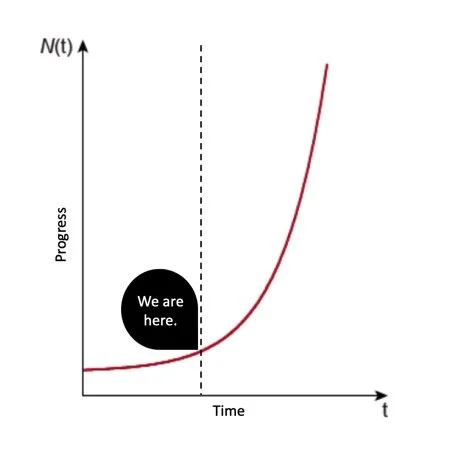
We are living in a world that, for the first time ever, is changing at an exponential rate.
But we are used to linear change, and cannot fathom what it means to make more progress in a year than what all of humanity has done in an entire century.
Here is a graph that shows what exponential growth looks like:
This rate and pace of unprecedented change means that:
You don't know anything.
No one else knows anything, either.
The goalposts are always moving.
The future is abstract and can go in a lot of unpredictable directions, some positive, some negative.
We are building our future using 30-year-old brain software that was programmed for a static, linear world.
Just to make sure you understand, here’s another graph:
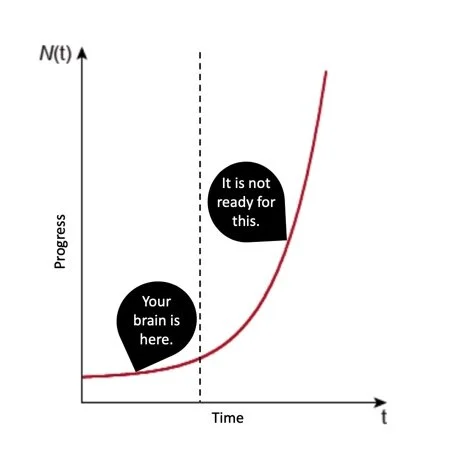
Our 30-year-old brain software was trained to follow the rules, memorize information, get good scores and grades, and land a good job that would set us up for life. Thinking outside the box did not help you in this game.
That was OK a linear world. In today’s exponential world, pretty much everything you've learned is irrelevant, and anything you will learn in the future will only be relevant for a blip in time. Other trends beyond technology–like diversity and generational change and the rise in gig-based work models–require a different set of skills for success today and in the future.
Social and emotional skills like creativity, empathy and cultural fluency are now survival skills. As the rules change, you have to be able to think out of the box and work in new ways to adapt and continue to add value.
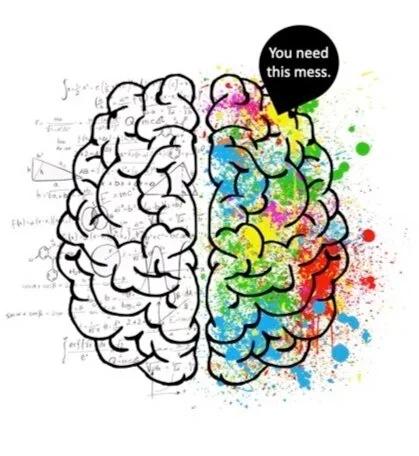
Research says we were born innately creative, but our education model trained it out of us because thinking in abstract, novel and different ways wasn't useful in a world where following an established path was how you succeeded. Our brains need to be reprogrammed in order to thrive in an exponentially changing world.
Education models and research methods tend to look through the lens of what already exists, what's been done before. Art and creativity look through the lens of imagination, how to bring abstract things into existence, and create the future. I am obsessed with this idea of how to cultivate human brains in new ways so we are not just iterating on what's already out there and getting left behind, but morphing the future into something better. And in a world that is changing faster than ever before in human history, we needed to be all over this yesterday.
If you think of our individual human brains as seeds, and the environments where we operate our brains as gardens, the current garden lacks essential nutrients so the seeds are dying.
So we need to be considering what fertilizer we need in the garden (i.e., educational systems, learning and development programs, collaboration models) to save the seeds we have right now. I completed a six month sabbatical research project focused on this question: "How might we teach adult brains skills like social and emotional skills like creativity and empathy?" This is not a new question, by the way.
There is a growing body of research looking at the interrelationship between social and emotional skills, specifically empathy and creativity. In considering how to focus a sabbatical project, I reviewed existing research specifically on where focusing on one skill might influence the development of others.
A common thread emerged: self-awareness, attention and mental flexibility are foundations for skills like creativity and empathy. (Standford has a curated set of studies and resources focused on the question of how empathy and creativity influence one another.)
Current research does not have a definitive answer about how to develop social and emotional skills like empathy and creativity.
The insights about the interrelationships between these skills convinced me to focus on one specific skill in an exploratory research study framed as a workshop at The Art Institute of Chicago.
After doing some concept testing with potential participants on empathy-related goals versus creativity-related goals, there was a clear preference for creativity. (I hypothesize that empathy-related goals were perceived through a negative lens (i.e., I have a problem), whereas creativity-related goals were perceived as a positive (i.e., I have an opportunity).
So, I focused the workshop and exploratory research specifically on creativity, and designed the content to look at interrelationships between both skills.
There was a challenge in designing this workshop and exploratory study focused on creativity: researchers don't even agree what creativity is, exactly. Some say creativity is a moment of inspiration like Sir Isaac Newton had, others say it's a practice of self-expression (like painting or songwriting), and many say it's a thought process like brainstorming.
But there are a few of common threads of truth across the varying creativity research studies and theories:
That creativity is innate in every human, and is unlearned
That creativity is affected by our environments and influences
That creativity is limited by fear, judgment and self-editing
This is not new, or revolutionary. It simply means that creativity can be learned, and that we might be able to help people develop it by making changes to their environments and habits, and by making changes to their mindset.
I wanted to better understand how we might do this with real people, building on the available creativity research and exploring what happens when:
Orthodoxies and belief systems are challenged
Environments and daily habits are called into question
Narratives are shared in engaging, unfamiliar ways
I decided to test these questions using a human-centered method, leveraging a number of creativity research studies including the work of Brian Uzzi at Northwestern University, and Keith Sawyer at The University of North Carolina at Chapel Hill.
The project was originally designed as a series of workshops at The Art Institute of Chicago, with input from the Ryan Learning Center (special shout out to Nenette Luarca-Shoaf and Sam Ramos) and Ray Williams at The University of Texas at Austin. However, the program was scheduled to start two weeks after the global pandemic came to Chicago.
So, I pivoted the content into an email-based challenge called "28 Days of Art." The virtual format had constraints, but allowed a lot more people to participate and generate data.
The challenge was advertised as a simple, once-per-day email for 28 days that would expose participants to art and information about creativity, and ask them to complete a 5-minute exercise to boost their own creativity. Participants were sourced by promoting the challenge through my personal networks (LinkedIn, Instagram, blog, newsletter, colleagues, friends, etc.). About 100 people opted in, and shared data through surveys, email-based feedback and a selection of deep-dive interviews with ~25 of the most engaged participants.
Here are the observations about how to become more creative that came out of the 28 Days of Art exploratory research study:
Almost all participants had identity-based beliefs about their creativity, which affected how they explored their own creative potential. The observations fell into two buckets based on these identity-based beliefs.
#1 Participants who identified as “uncreative”:
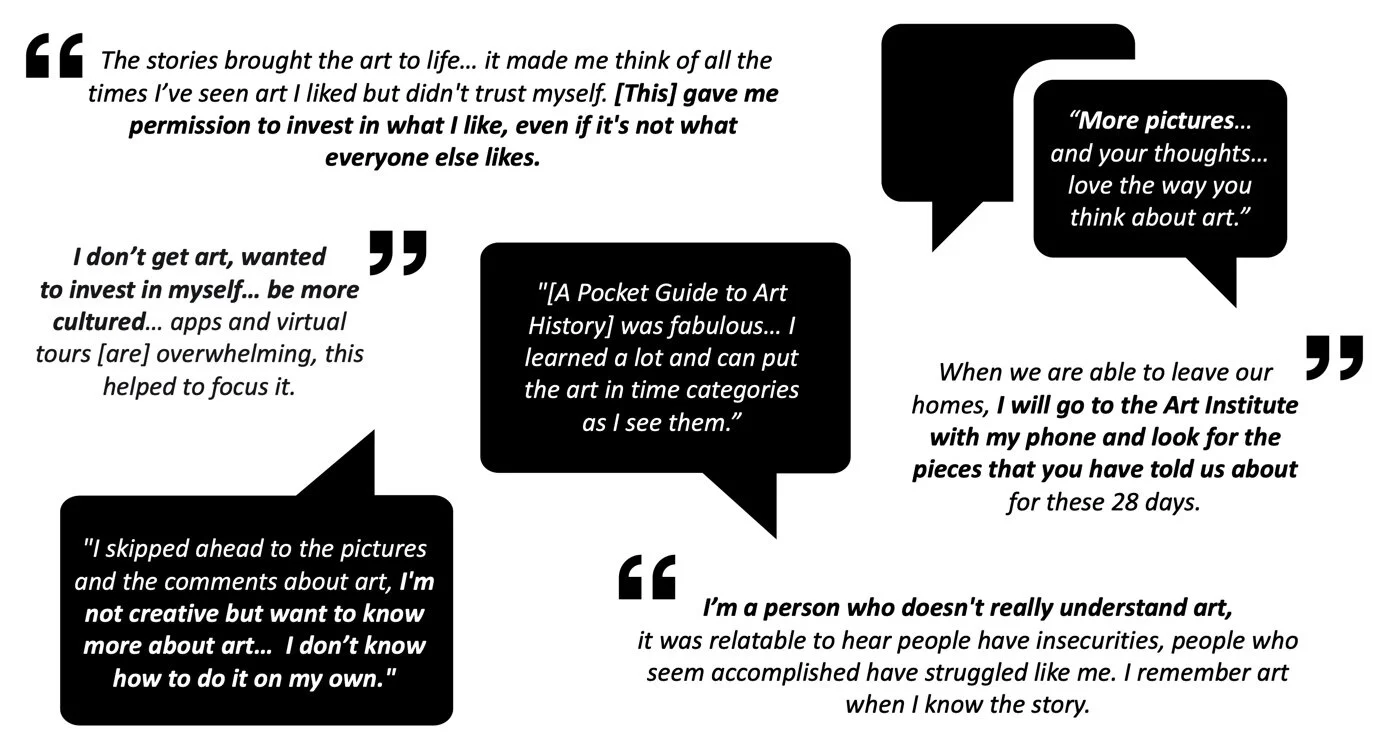
Participants who identified as "uncreative" fell on a scale that ranged from a fixed view of creativity as a personality trait in only certain people (and signed up for exposure to art, "to become more cultured") to a flexible view of creativity as a topic they did not understand (and signed up because it was important to learn more).
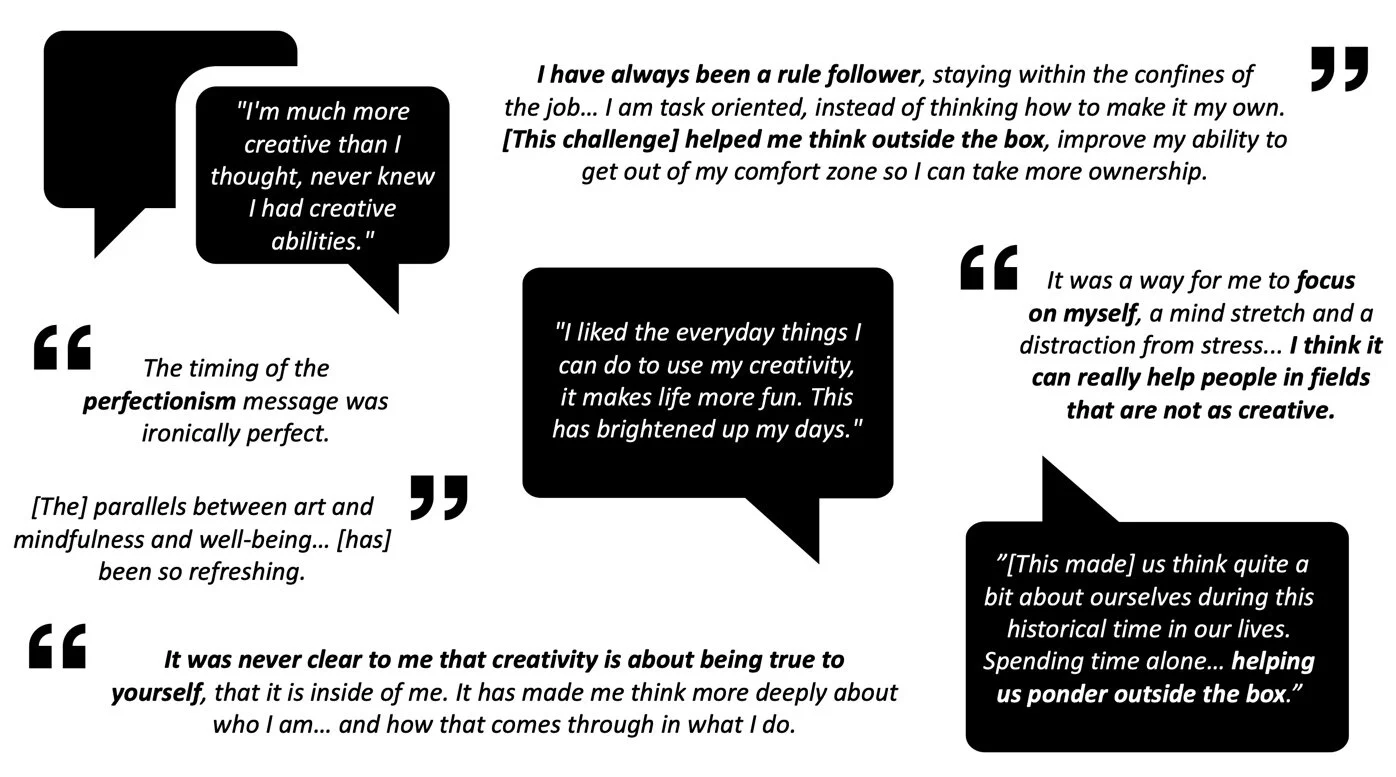
Feedback centered on themes of self-awareness and introspection. One insight gleaned from this group is that many held fears about engaging with art on their own (versus in a curated setting), and felt connected to the art that was shared with a narrative about the artist’s human experience.
Here are direct quotes from the group that identified as “uncreative”:
#2 Participants who identified as “creative”:
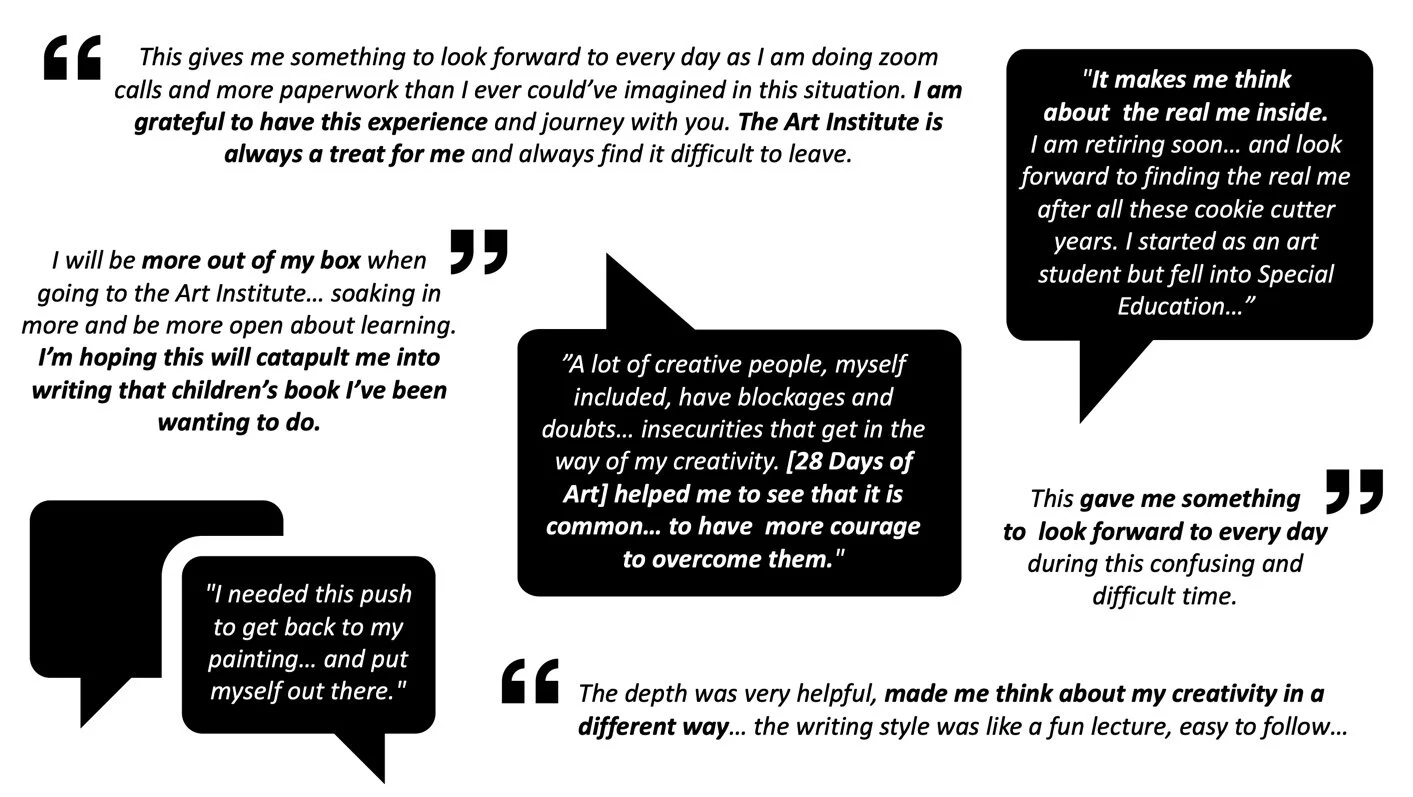
Participants who identified as "creative" largely signed up for motivation and accountability to make their creativity a bigger priority in their life, with reasons given like "invest in myself," "de-stress" or "find more joy," with the largest segment being people who "used to be creative" and wanted to get back in touch with a creative practice after "losing it" during a life phase (i.e., children leaving for college, approaching retirement after a stressful career). Some considered themselves highly creative and wanted fresh perspective about how to engage with art, develop better creative habits, and overcome blockages.
Here are direct quotes from the group that identified as “creative”:
Here are the insights about how to develop creativity skills in adults that came out of the 28 Days of Art exploratory research study:
Creativity research was helpful in challenging orthodoxies and inspiring curiosity (particularly in participants who identified as "uncreative").
Logical thinking and mindfulness exercises were helpful in managing fears that block participants from taking risks such as engaging with art outside of a curated setting, or making themselves vulnerable by sharing their own experience through a creative channel (particularly those who identified as ”uncreative").
Introspective exercises were helpful in opening their minds and thinking outside of the box, across all segments, and helped participants find common human connections with art and artists
Providing context and stories about individual pieces of art was helpful for remembering and applying concepts about creativity and empathy to daily life, across all segments, because it inspired emotion.
Tiered exercises for varying levels of comfort (i.e, beginner), and an easier format to self-pace through the content and capture notes (i.e., a workbook), multiple modes for how to consume the content (i.e., audio, video) were feedback themes.
A community model to drive accountability, recurring weekly or monthly content to continue providing exposure and commentary about art, and exercises to practice concepts were feedback themes from participants who identified as "creative.”
This project is continuing on to further refine these observations and insights, as well as continue to support the people who participated. If you are interested in more information, please reach out to me at colleenbordeaux <at> gmail <dot> com.
Quisque iaculis facilisis lacinia. Mauris euismod pellentesque tellus sit amet mollis.